The Book Of Help

Blurb:
Think back on a time you were desperate. Perhaps you lost a job, or got very sick, or lost someone dear. In that moment, did someone help you get through? Or, if you’ve been lucky enough not to have experienced that sort of need, was there ever someone who helped get you to where you are today?
None of us escape life without help, no matter how talented, hardworking, or lucky we are. In fact, luck is often delivered in the guise of help from others.
But we don’t often think of help except when we need it. And it turns out that there are all kinds of very specific unwritten cultural rules to how you ask for help if you want to succeed.
At the same time, technology is evolving culture ever faster, and it is now both possible and necessary to follow a whole new set of rules when asking for help.
The Book of Help is a practical handbook for how to ask for help and maximize your chances of getting it when you need it.
Table of Contents:
Introduction
The culture of helping
Why we help
How to ask for help
Technology and change
On helping
A note on gratitude
Chapter 1: Introduction
My grandmother lived to be 93. To the very end of her storied days she lived by herself, active and engaged with a world she had seen change completely. She was many things to me, and often say I can trace lots of my own quirks right back to her. She deserves a book of her own, which perhaps someday I will write.
For now, though, the reason I bring her up is that I think it was she who made it hard for me, until this very day, to ask for help. Not that Grandma was arrogant, but her German roots (so she claimed) made it hard for her to make herself vulnerable. By the same token, she was extremely sensitive to when people needed help themselves, and made a point of offering and giving assistance wherever she saw need. What drove her nuts was seeing people NOT help.
When I was really young my parents were unemployed every once in awhile, and my Grandma and Grandpa would go to the grocery store and buy them groceries and pricey things like meat, which they couldn’t really afford, and bring the stuff down to our house by the carload. My Mom, by the way, would never have asked for that, either! Pride runs strong.
In my life, my first credit card was the first step not having asking anyone for help. Which isn’t strictly true, since putting something on credit is implicitly asking a bank for help, but the fact that a bank is faceless makes it easier to “ask.” More on that later.
I was so excited when I got that first American Express Blue Card along with a free t-shirt and some bonus miles which I had no idea what they were at age 18. From then on, I would always choose to put things on credit rather than ask even my own parents for help. I would literally rather pay late fees than admit I needed the cash. Not asking for their help was a way of showing my independence. Also more on that later.
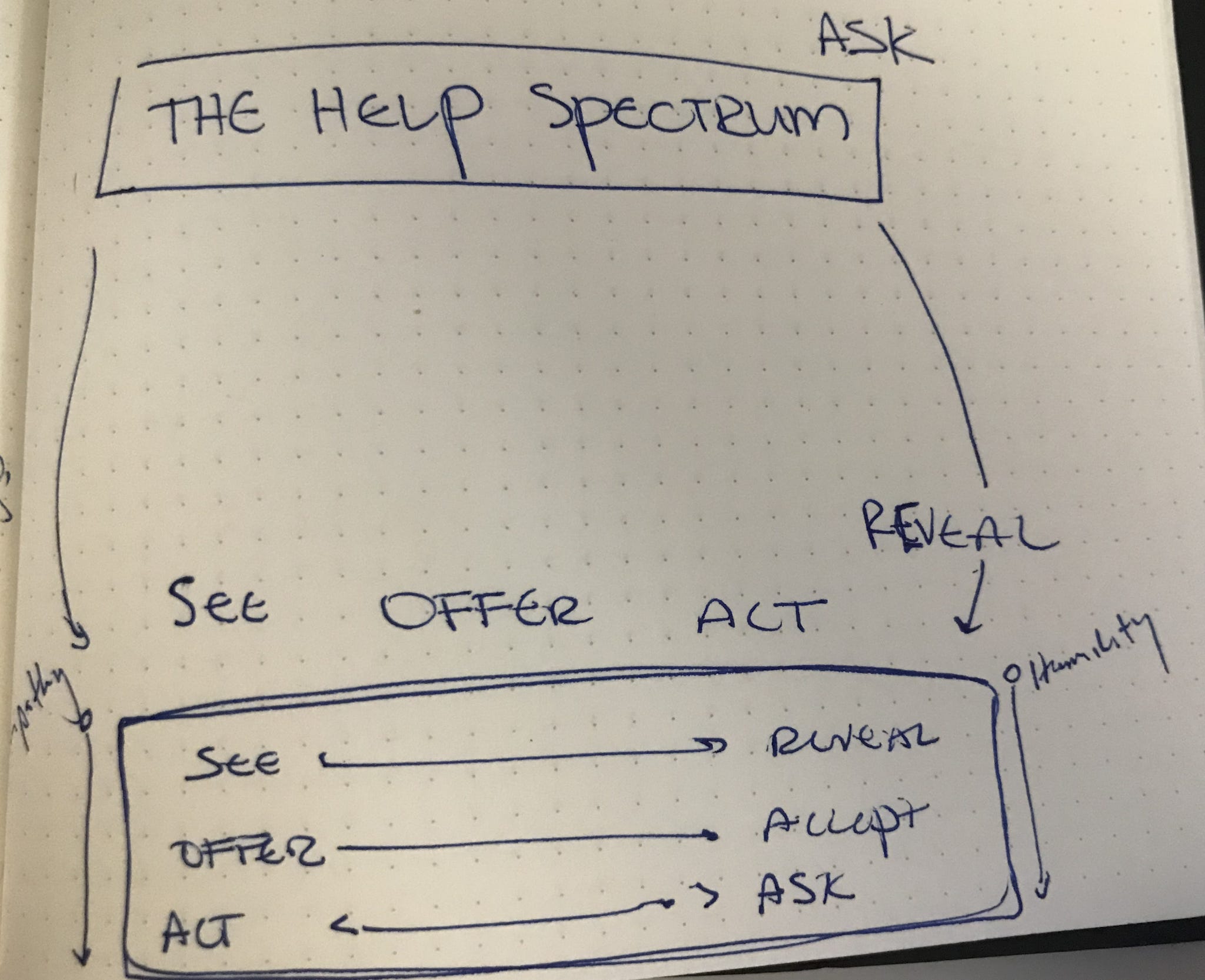
There are two sides to every story though, and my Grandma’s view of the world isn’t the only one. There’s another part of my family which is Italian. In their view of the world, when someone needs help they must be humble enough to ask for it. In other words, it isn’t the job of the giver to see the need, it’s the job of the taker to express it. Once you asked, they would give you the shirt off their back.
My Mom took after the “you must offer help” side of the family, while her brother adopted the “you must be humble enough to ask” philosophy. Honestly I have no idea if those two worldviews really belong to Northern Europeans vs. Southern Europeans, but it was a handy shorthand for my Grandma, who would go nuts whenever she saw people not offering to help.
This is all sort of interesting and I’m sure your own family falls somewhere on the spectrum I just described. But that’s not the reason I decided to write this book.
The reason I decided to write this book is that I believe the world has tilted irrevocably in the direction of “you must be humble enough to ask.” In this new world, one in which people lead lives of minimized social commitment in online communities, asking for help is the only way to get help. That curated self we all create online has made it impossible for others to know if we are doing well or poorly, and so it has become even more important to understand how to ask for help.
Those same technological and social changes that have made it hard to offer help, however, have made it extremely easy to ask. Perhaps even more importantly, they have made it even easier to actually help, albeit in very, very small increments. But the connected world is a very big place, and if you ask for help in the right way I can guarantee that the aggregate help you can get from your own network and beyond will literally blow you away.
So that is what this book is about - the new context of asking for and giving assistance, and how to navigate it well even if it turns my Grandma over in her grave. Sorry, Grandma!
The “Help Me” Phenomenon
Years ago, back in simpler times, a request was shared into my feed that I hadn’t seen before. A high school student was raising money via a crowdfunding campaign to go on a European backpacking trip.
My first reaction was to think “that’s in such bad taste.” After all, she was raising money to just go do something fun. My wife commented on the story as well - it had popped up in her feed separately from mine.
As I got to thinking about it, however, I came to an embarrassed realization. I had taken that same trip at her age. Same age. Same passion. Same curiosity to see the world.
But my parents paid for my trip.
I never had to ask anyone for help because a) My parents saw the need, and; b) They were in a position to help me.
How could someone like me judge a kid like that for asking her network to help in small increments with something her parents could not afford?
That’s when I realized that whenever we judge someone for asking for help it is generally because we don’t stop to put ourselves in their shoes. If we did that, truly, we wouldn’t only accept the request, we would offer help without being asked.
Telling, isn’t it?
Chapter 2: The Culture of Helping
The Instinct to Help
Have you ever heard a baby start crying near you, and in the instant before you get annoyed you feel a strong urge to give it succor? There is a reason for that. A baby represents two things that underlie the culture of help. The first is that we help those to whom we relate, with whom we feel a connection. We’ve all been babies, we all relate to them, even the most curmudgeonly of us. The second is that we have an urge to help those who are vulnerable, but only babies display their real vulnerability. There is an almost linear relationship between age and how willing you are to show weakness.
These two ideas, helping those with whom we connect and showing vulnerability, are the ingredients that make up help culture in every culture. Some cultures emphasize showing vulnerability, some emphasize helping those to whom we relate and relating to as wide a circle as possible.
My friend Jacco told me a story the other day which brings the point home. He got called by his daughter’s school to inform him school was closing early because of a security threat of some kind. When he arrived at his daughter’s school he noticed that his neighbor’s kid was waiting around with no one to pick them up. Despite the fact that he and his neighbor had recently gotten into an argument over whose dog should be pooping where, he offered the girl a ride home because he had an instinct to help. The instinct seems to intensify under stress.
A Bias Against Asking
Does this sound familiar: you’re struggling to move something heavy and someone offers to help. You immediately respond with “I’m fine,” even though you clearly are not. Why do we do that?
Just as we have a strong urge to help those we see in need, our instinct not to ask for help runs very deep. It has been acceptable to ask for help on behalf of a group or cause, or on behalf of another person, but not on one’s own. The west has an individualistic culture, and this plays out very strongly in how we perceive help.
It’s a bit ironic that the higher the station you achieve in life, almost always with the help of others, the less likely you are to ask for help. Again, that is related to the bias we have in most cultures against showing vulnerability and the ideal of an unassailable leader.
A few weeks back I was in London having lunch with a friend. Over our spring rolls I told her about The Book of Help and the importance of asking for help, and like a lot of people she nodded and said “that’s right!” She paused, and then followed up with “well, I can see asking in public for people who are desperate, but I could never do that.” She is a very accomplished CEO, and a member of my generation, which still recoils from showing vulnerability in public.
But what is it about showing vulnerability that makes us avoid it? Part of it comes from calculation. We give to those with whom we connect, and we don’t connect with those whom we perceive to be different. Desperate is different. Desperate is something I could never be. Right?
Vulnerability Creates Opportunity
Few places in the world are more open to failure than Silicon Valley. I’ve spent a good chunk of my life here, and the culture, special in so many ways, is also special because it encourages vulnerability. Like most cultures, it comes with a certain amount of ritual.
When you do a startup in Silicon Valley you need help with just about everything, particularly if you are a first time founder. The way you get help is by asking for it. The way you ask for it is by going out for coffee.
Anyone can ask for coffee with anyone in Silicon Valley and the request will be considered. In the meeting itself, there is a ritual. First, the asker will talk about their background and their idea. They will touch on what their challenges are, and how they will go about tackling them. The ritual touches on many of the points I’ll talk about in this book - how to present your case, how to create a connection, and how to make it specific.
But at some point in every meeting, the person who was asked to coffee will say these exact words: “So, how can I help you?” It happens almost without fail. Think of the power of those words! Whether it is through an introduction, or a piece of information, or even some work done pro-bono, the giver is acknowledging the fact that, hey, we’ve all been there, and I will pay it forward.
There are few vulnerability cultures to match the one in Silicon Valley. Academic institutions are a close rival, and their environment is even more unique and sheltered. What they have in common is that they have made it possible to show weakness without fear of negative consequences. It’s no surprise that these types of places are where the greatest cooperation and advances in knowledge happen in the modern world!
The 4 Help Blockers
Help Blocker 1: Fear of Commitment
This is probably the number one barrier to helping others. The fear of commitment. We even fear commitment when it comes to things we are excited about, like girlfriends/boyfriends, signing up for a soccer league, or even making plans for this Friday night.
Help Blocker 2: Rejection of Difference
We help people we think are like us. If they are different for whatever reason, the chances we will put ourselves out drop like a rock. What amazes me is that “different” can often mean not that our backgrounds and circumstances aren’t the same, but rather we don’t want to imagine ourselves in a similar situation. So it’s easy to see why we don’t want to give money to beggars on the street. But even when we know those people have gotten into that situation from no fault of their own we still try to push them away from us.
Help Blocker 3: Contempt of Desperation
For some reason we don’t like to help those who seem desperate. The longer someone stays unemployed, for instance, the harder it is for them to get a job. Logically, one would think that the longer someone is unemployed the more likely it is that they would work at a lower wage and therefore a better value, but people are not rational.
Help Blocker 4: Fear of Cheating
Particularly when we are asked for help by someone we don’t know, our first instinct is to suspect a scam. In another irony, it is usually scammers who are good at allaying these fears because they understand the dynamics of help better than anyone.
Chapter 3: Why We Help
Why do people do anything at all? Motivation is one of the mysteries of the human condition. That said, I’ve found that when people decide to help you they are motivated either consciously or unconsciously by a few consistent drivers. It’s important to note that none of these are intended to convey a value judgement. Regardless of why you help someone there is value in the act. And, as we’ll see later, it is important to understand motivation when you ask for help from others.
Altruism: when it just feels good to give. The act of helping itself brings pleasure and that is enough.
Empathy: when we feel a connection to those we help. The connection can be strong, as in the case of family, or weak, as in the case of a likable stranger. In both cases the driver is the person we are helping.
Responsibility: when helping is required for social reasons. This could be cultural expectations, legal requirements, or anything else that compels us to assist when we otherwise don’t want to.
Quid pro quo: when we help in the expectation of being helped in the future.
Guilt: when we help because we feel bad. There is a subtle difference here from empathy, in which we feel bad for the person individually, instead we ourselves know we will feel bad if we do not help.
Status: when we help because doing so validates our position in society. There are all sorts of permutations of this motivation. What they all have in common is that the act of giving is known to others.
There are probably many other motivations for helping others, but in my experience most of them fall into one of these broad categories.
Responding to the Ask
Generally speaking there are three ways to respond to a request for help. They are:
Amplify the request by sharing it or making an introduction
Give money
Give time
That’s it. Interestingly the Perceived Energy Cost of Help often increases as you move down the list, but the most valuable thing you can do is often the easiest: Amplification.
The Surprising Effectiveness of the Group Ask
When you ask someone to assist you face to face, the Perceived Energy Cost of Help is really high, but then so is the pressure for them to agree, driven largely by the instinct to help. It is a high-risk, high-reward strategy at the micro level.
But if you think about it, how many people can you ask for help from face to face? How much time and emotional energy does it take? What is the likely outcome of the strategy overall?
Conversely, if you ask a group of people, the Perceived Energy Cost is low, because everyone knows they are not obligated to do it. There is little pressure for them to agree and they are more likely to make excuses not to do it.
On aggregate, however, asking for help from a large group of people, particularly when large is defined as your entire network and even a degree or two of separation, is a far lower risk proposition. Arguably the likely outcome of the overall strategy is better too, if you ask right, which we’ll get into how to do it a bit.
The Importance of Intermediaries
Imagine the following:
Scenario 1: You work in a competitive industry at a high profile firm. You receive an unsolicited offer from someone who seems to have reasonable experience but has a gap in their resume. You are very busy, and know that taking the call will take from other important projects.
Scenario 2: Now, imagine the same situation, but the candidate is introduced by someone you respect. The introducer mentions the gap in the CV and explains it had to do with a family tragedy.
Are you more likely to take the call in the second situation? Of course you are! We are social animals, and for better or worse we perceive having an intermediary as reducing risk. The amazing thing is that this doesn’t only apply in one-on-one situations.
I recently saw a request in Facebook by my cousin’s wife. In it she said that she was sponsoring a refugee family via the International Rescue Committee and asked her network if we could help with money or supplies. I couldn’t get my checkbook out fast enough.
Let’s review here: I’ve gotten plenty of requests from the IRC itself in the past. This is a large, well known, clearly-not-a-scam organization. But it took my cousin’s wife acting as an intermediary to give them enough social proof for me to take action.
In Help Energy terms, having an intermediary massively lowers my Personal Help Multiplier.
The easy lesson to be drawn from this is that if you are going to make a request, even if it is a broadcast request to your network, do it via intermediaries!
This is a big part of the reason that the value of help via Amplification is so high relative to help via other methods.
Help in a Small Community
My sister is a diplomat, which makes me tremendously envious. Because of her job she often lives in very small, tight knit communities, the sort you only get in very small towns, cults, and certain groups of gamers. These communities don’t last long, because everyone is transient, but the dynamics of help play out very clearly.
She told me a story about being posted to a hot, remote, and very unimportant diplomatic post manned by just eight of her colleagues. In that group it was often, or always, necessary to help each other. They all couldn’t leave for lunch at once, for instance, so someone had to stay back, as well as any number of other little things they did to help each other with work and life.
Into this group arrived a guy responsible for diplomatic relations. His job (no one else’s) was to have a variety of social interactions with the locals in order to build trust and mutual understanding. Soon after arriving at post, he sent an email to all eight staffers that said the following:
“I need to staff several events in the next few months. Here are the time slots available. I recommend you do this because it will look great on your employee evaluations.”
I’m paraphrasing, but you get the gist. In the world of help this guy literally did everything wrong. The guy was a recent arrival and had made no efforts to build relationships with the team, so he had no existing connections to rely on. He made no reference in the email to what he would be doing himself, or what value this work might have on him or even on the bigger picture. In the moment, he made no effort to establish a connection with or show vulnerability to his audience, he just asked.
He got no takers, except my sister, who is one of those people with an extremely high help multiplier.
By the way, after my sister agreed he didn’t make it easy for her to help nor did he show appreciation afterwards.
It’s almost as if he pre-read this book and decided to not do everything it suggests.
Chapter 4: How to Ask For Help
To ask for help effectively you must create a connection, be specific, and make it easy to take action. If you do those three things well then people will help you.
Create a Connection
The secret to asking for help is creating a connection. People will only help you if they care, and they will help you pretty much in direct proportion to how much they care. So it kind of makes sense that the best way to get people to care about you is by making some kind of connection.
The best possible connection, of course, is one that exists before you have to lean on it to ask for help. This book isn’t about that scenario, since there is all sorts of advice out there on how to make friends build your network.
If you are asking strangers for help, you have to establish a connection in the context of your ask. It is very hard to do that without coming across as inauthentic. We all hate the email or Linkedin connection in which an overly eager asker says something like “Hi Fernando. I noticed we both do triathlons. I was wondering if you could introduce me to so-and-so?”
A salesy, transparent approach will always trigger the Fear of Cheating.
Instead, here are some elements of an ask that will always convey authenticity.
Demonstrate what you have done for yourself
You have to put in the work. No one expects you to be able to solve your own problems, but everyone has their own problems to deal with. Make it clear that you value and honor people’s time by making as much progress on your own as you can, and then conveying that in your request.
A lot of people mess up this step because when they describe what they have done they implicitly or explicitly place the blame on others for their situation. That is also a turnoff - triggering Contempt for Desperation. Instead, in laying out what you have done you should also accept responsibility for your situation! Only you own your destiny and that is the type of strength that people want to help.
It sounds hard, but the idea here is to demonstrate what you have done while being humble about it.
Know your audience and give them touchpoints
World class marketers, speakers, and leaders all say the same thing when it comes to knowing your audience. You have to answer a question for them: “why do I care.”
Asking for help from an individual or from a group requires the same level of understanding. You can take this exercise to extremes, but here is a simple 1-2-3 framework to know your audience.
Who - are they and what do they have in common. This can be a school, an occupation, an interest. It is often the reason for which they are listening to you in the first place.
When - do you have their attention? And why now? If they are reading about you in their Linkedin Feed they are browsing and you have very little time to make an impression. If they are reading a forwarded email they have slightly more time. And so on.
Why - would they want to help? Think back on the reasons why people help. Empathy, guilt, status, and so on. For example, as a writer I often interview people who have no obvious reason to share their insight. But when offered the chance they will talk at length about things that they are experts in. If I’m brutally honest I believe that what motivates this is a desire for status. Which is fine! This knowledge leads me to ask lots of questions, compliment them on their knowledge, and make them feel good about themselves and possibly seeing their names in print.
If you do each of these things in the preparing for and carrying out your ask you are much more likely to be authentic and create a connection.
By the way, there is a little-noticed effect that I have come across over the years, and that is that asking for help, if done right, can help create a connection in and of itself.
Be Specific
Set a reasonable goal
Make clear how their help will improve your situation
It used to be that civic institutions did the “packaging” like church drives and so on. That’s all decentralized now, but you have to provide the same level of context “this drive benefits XYZ”
Make it Easy to Take Action
Take advantage of technology
Provide easy options for each type of help
Click to share
Intro to refer
Click to pay
Invest time
Chapter 5: Technology and Change
Help is just a click away
It has become fashionable to complain about the negative effects technology is having on our society. These range from all sorts of cognitive issues to the breakdown of the very fabric of civilization. My own take is not only that these fears are overblown but that we consistently discount the tremendous benefits that technology gives us because we get used to them so quickly.
And so it is with technology’s effect on help. People might complain about the edge cases in which a spoiled child tries to raise money from strangers for her backpacking trip to Europe. But the fact is that our connectedness, our availability, and our ability to take action in the digital space have made it ever easier to both ask for and give meaningful help.
I am struck by an story I read about recently in the news. A train in New England collided with a garbage truck and its driver was killed. He left behind a wife and infant child. There is no way his widow could have known how to ask for help in her grief. But someone who understands the technology of help created a fund for her with the goal of raising $50,000. As I write, donations had reached $100,000. She can’t be compensated her for her loss, but her uncertain future has been made a lot better by the kindness of strangers and technology that makes it easy to ask for and give help. That simply wouldn’t have been possible ten years ago.
Culture itself is evolving
It’s not only technology that has changed how we ask for and give help. As with every other social question, this is one whose boundaries are constantly being redefined. Today, younger generations that came of age in difficult economic times and who were raised in much more of a team-based learning environment do not hesitate to ask for help from their peers.
Like with lots of other social issues, there is no right or wrong to be had in the discussion. Acceptable behavior is simply what is accepted, and for those of us who have a problem asking for help at the top of our lungs...well, that’s our loss.
Mobility
This is hardly news, but the process of kids moving away from their parents and grown ups following the best job opportunities continues apace. Cities are getting bigger and more anonymous, and we tend to have smaller in-real-life friend groups.
What that has meant is that the high levels of empathy that come from being in a small, tightly knit community have fallen. We have fewer people to turn to when we can’t get through things on our own.
The Curated Self in Social Networks
As a rule we put our best foot forward online (when we do so under our own name, anyway). We are always having fun, we are always on vacation, we are always trying something interesting. No reasonable person could look through the average social network feed and reliably discern whether that feed’s owner is happy, sad, or in need.
That is a huge problem when it comes to signaling for help. Interestingly, the people who are most likely to portray their lives in an “everything is fine” way online are also the ones most likely not to ask others for help or admit they can’t do it on their own - they become prisoners of their own narrative.
Global Online Communities
To counter this increase mobility and curation, online communities have become so prevalent that many people have larger communities in the digital space than they do in the real world. The jury is still out on the social, cognitive, and emotional effects of that transition, but when it comes to getting and offering help, the verdict is clear: online communities are a huge source of support and assistance.
In fact, many online communities arise specifically in response to that need, whether it’s support groups for medical conditions, financial problems, or any other crisis that brings people in need together.
Even a sports related group, however, often creates the necessary bond for mutual assistance. I am on a Triathlon group online, and several times over the past few years there have been requests for assistance on behalf of members who have fallen on hard times. Importantly, these requests don’t always relate to the topic of the community - accident victims are equally likely to get help as are triathlon-related injuries.
In some ways, online communities provide a similar level of intermediation as a personal introduction. Belonging to the same group isn’t as good as having a personal connection vouch for a help request, but it is a good second-order proxy.
Online Assistance Platforms
Separate from generic social networks, Online Assistance Platforms like Go Fund Me represent the ultimate evolution of help culture - the digital embodiment of the Dynamics of Help. In fact, a lot of the theory in this book plays out directly in practice on Go Fund Me.
I’ve spent a lot of time looking at Online Assistance Platforms in researching this book, and it is amazing how they represent everything that has changed in the world of help, as well as everything that has remained immutable.
If you haven’t already, you should have a look at www.gofundme.com. One of the most amazing things about the platform is that at the very highest level it is organized around all the different types of help that can be requested and given.
There is even a specific section devoted to people asking for help to go travel, like the student I mentioned earlier. Every kind of trip, for every kind of reason, is represented, with requests made both directly and on behalf of others.
I’ll come back often to Online Assistance Platforms and how their use informs an understanding of how help works today.
Chapter 6: On Helping
See the Need
Sometimes it’s obvious, don’t second guess yourself
Commit to helping first
That no one else is doing anything isn’t an excuse
See through the curated self
Watch out for euphemisms
Make the Offer
There is often a weird hangup here
There are three ways to help
Amplify the request
Share
Make introductions
Give money
Give time
Follow Through
Sometimes it’s just obvious
If you say you will help, recognize that you have taken on an obligation
Chapter 7: A Note on Gratitude
There’s been a lot more written about gratitude than there has been about help - see any of the major religious texts
That said - be grateful. It’s good for you, and it’s good for others.
The more you help people who aren’t like yourself, the more you are saying, literally “we are all the same”
Grateful for friends and family
Friends can almost be defined as the people with whom you have a pre-agreement to help.
“Would the be there for me” is pretty much the measure of friendship, and I have given up on friends who didn’t measure up.
And family is the help of first and last resort.
Appendix: Nerdy Stuff
Help as Energy
We may not always think about it in exactly these terms, but we understand instinctively that help requires energy. In fact the metaphor of energy is useful in several different ways.
First of all, the energy cost of helping someone can actually be summarized in a nice little physics-like equation (though of course it is nothing like physics):
PERCEIVED ENERGY COST OF HELP = TIME X DIFFICULTY X PHM (PERSONAL HELP MULTIPLIER)
Time and difficulty are easy concepts to understand. What I think is more interesting is the constant in the equation, the Personal Help Multiplier (PHM) unique to each person. If your multiplier is low then you help a lot and are generous with your aid. This doesn’t have to do so much with how much energy is actually required, as with your perception of that energy. My father had a PHM of almost zero. He would go miles out of his way to give someone the shirt off his back and never think about what it cost him.
Another interesting set of properties around the energy of help have to do with the conservation of energy.
The inertia of help - often the reason we decide to help someone or not comes down to whether we are willing to commit the energy. If we haven’t been helping a lot it takes a lot more energy to get started.
The momentum of help - conversely if we’ve already been helping people it becomes easier to keep doing it.
Help as Accounting
We often think of help in terms of favors done, which is not a very nice way to think of it, but a common shorthand. Whether it’s credits or debits, people tend to be keenly aware of where people stand in their “ledger.”
I don’t think you should think this way - in fact I think you should just give and give and give.
It’s good to know that others think this way though, because it underlies a lot the behavior involved in offering and responding to requests for help. In particular, if you have never done something for someone it limits how much you can ask of them.
The Help Spectrum